

Everything you need to know about

When hazardous noise cannot be reduced by other means, employers are responsible for providing appropriate hearing protection, such as earplugs or earmuffs.
In case your employer operates under federal jurisdiction, you are entitled to protection from health hazards in your workplace under Part II of the Canada Labour Code. Moreover, if you are concerned about exposure to high levels of sound in the workplace, Part VII of the Canada Occupational Health and Safety Regulations, named "Levels of Sound," addresses this issue. It is mandatory for every employer operating under federal jurisdiction to abide by these regulations.
Ear Personal Protective Equipment (PPE) can help to reduce the amount of noise that enters your ears and protect them from damage. It is especially important for people who work in industries where there is prolonged exposure to loud noises, such as construction, manufacturing, or entertainment.
It’s important for employers to provide several different types of hearing protection, to allow for worker preference, comfort, and size. If workers find equipment uncomfortable, impractical, or ill fitting, they probably won’t wear it. To best protect workers, the equipment must fit properly and be worn at all times.
Part VII of the Regulations aims to prevent hearing damage, and it sets guidelines based on the average exposure to noise, rather than a maximum sound pressure level. The term "noise exposure level" encompasses both the sound level and the duration of exposure to that sound level.
According to the Regulations, your noise exposure level should not exceed an average of 87 dBA over an eight-hour period. This means that you may experience sound levels above 87 dBA for brief periods as long as the average exposure over eight hours does not exceed 87 dBA. Please refer to the table below for more information.
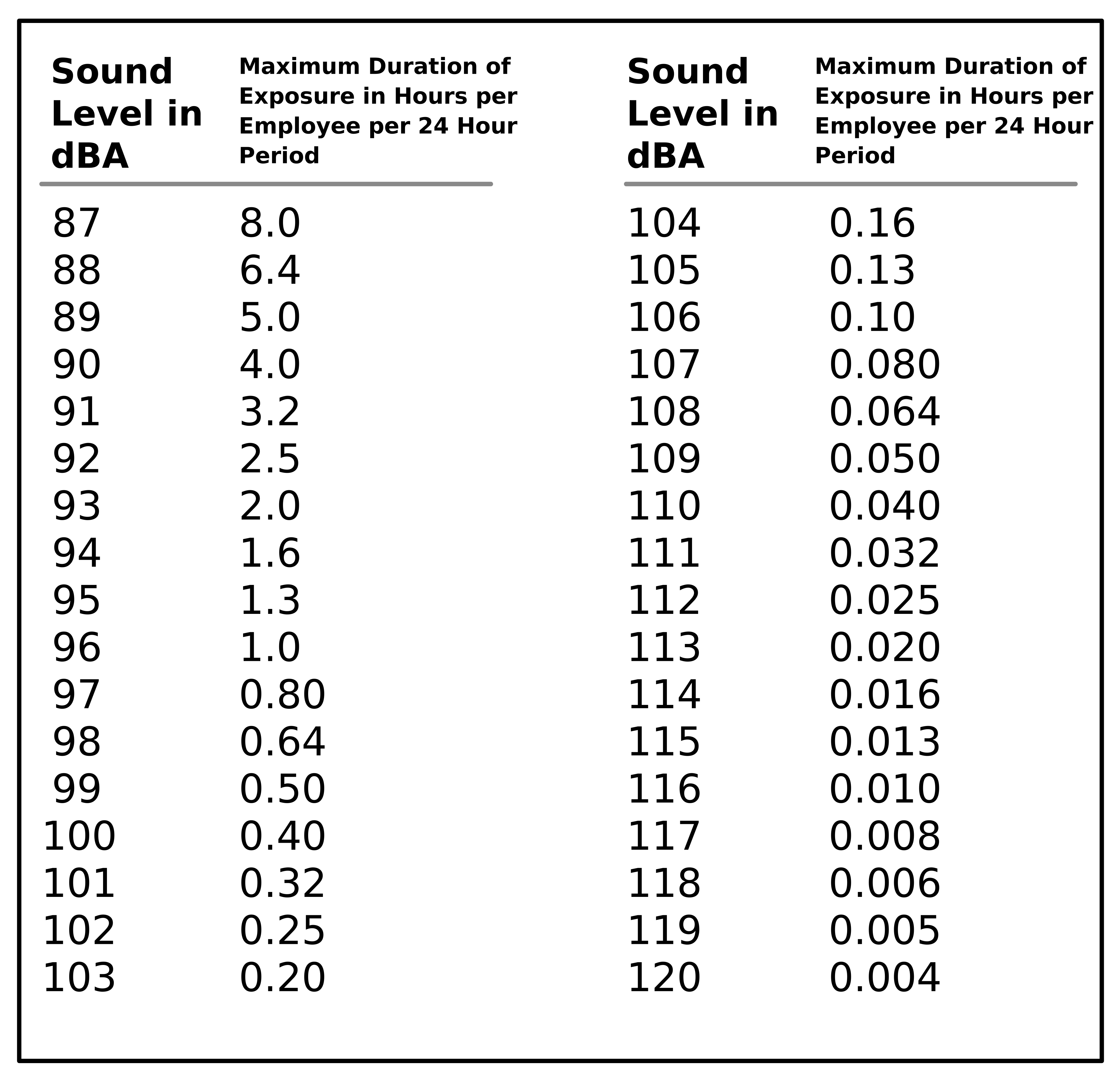
The dBA is the unit of measurement used for sound pressure on the eardrum. To measure the current sound pressure level, a sound level meter is utilized, while a dosimeter is used to determine the average over a given time frame, such as eight hours.
Exposure to loud noises, whether it is frommachinery, tools, or other sources, can lead to noise induced hearing loss overtime. This type of damage is often gradual and may not be immediatelynoticeable.
Tinnitus, a ringing or buzzing in the earsthat can be caused by exposure to loud noises. Tinnitus can be a chronic anddebilitating condition that can interfere with daily activities and quality oflife.
Earplugs are inserted in the ear canal. They may be pre-molded (preformed), moldable, rolldown foam, push-to-fit, or custom molded. Disposable, reusable, and custom ear plugs are available.
Semi-insert earplugs which consist of two earplugs held over the ends of the ear canal by a rigid headband.
Earmuffs consist of sound-attenuating material and soft ear cushions that fit around the ear and hard outer cups. They are held together by a head band.
Dual-Protection involves the use of earplugs and earmuffs.

Measure every employee's unique level of attenuation and take the guesswork out of managing your hearing conservation program. Hearing protector fit testing is a way to measure the amount of noise reduction, or attenuation, a hearing protector provides while it is being worn by a specific individual.
Devices used to measure how well hearing protectors fit a wearer are finding their place in workplace health and safety programs. These devices are commonly referred to as Field Attenuation Estimation Systems or FAES for short. They provide a measurement for the real attenuation provided to a user wearing a hearing protector like an ear plug or earmuff.
FAES will determine a Personal Attenuation Rating (PAR) specific to the wearer and the make/model/size of hearing protector. This rating often differs from the Noise Reduction Rating (NRR) for a given Hearing Protection Device (HPD).
The PAR can then be used to determine if the hearing protector provides adequate protection for the user. The recommendation is for workers to fit test their hearing protectors so, like respirators, the worker can better understand the level of protection they can achieve with a properly fitted hearing protector.
People should wear a hearing protector if the noise or sound level they are exposed to is close to or greater than the occupational exposure limits (OEL) for noise. For most jurisdictions, this occupational exposure limit is 85 decibels (A-weighted) or dBA.
Must fall under The Canadian Standards Association (CSA) Standard Z94.2-14 (R2019) “Hearing Protection Devices -Performance, Selection, Care and Use”.
The Noise Reduction Rating, or NRR, and other similar systems such as the single number rating (SNR), is a method to determine the effective exposure of a person when wearing a hearing protector more accurately. These rating systems attempt to estimate the actual sound protection provided by hearing protectors when worn in actual working environments (vs. laboratory testing situations). The “real world” results are often different than laboratory tests with the main reasons for this difference being poor fit, and lack of proper training, supervision, and enforcement. For these reasons, training on the correct fit, and making sure users have a thorough understanding of hearing loss are important elements of the hearing conservation program.
Detailed calculations of the protection provided by a hearing protector involves using octave band analysis of the workplace noise and the noise attenuation provided by the hearing protector for noise in each octave band. Attenuation is defined by CSA Standard Z94.2-14(R2019) Hearing protection devices — Performance, selection, care, and use as “the reduction in sound pressure level incident upon the ear due to the application of a hearing protector or, specifically, the change in hearing threshold level that results when a hearing protector is worn.”
Earplugs Percent of NRR achieved: 50%
Earmuffs Percent of NRR achieved: 70%
Dual Protection (use of earplugs andearmuffs) Percent of NRR achieved: 65%


