Everything you need to know about
WHEN DO I NEED HIGH-VISIBILITY SAFETY APPAREL?
Before choosing any high-visibility safety gear, it’s crucial to verify the legal requirements in your area. Specific activities might necessitate particular types of gear.
The CSA Standard advises conducting a hazard evaluation at each work location to identify any known or possible dangers that employees may face while doing their duties. This evaluation is essential for assessing the likelihood of workers being struck by vehicles and the work conditions they’re subjected to. For further details on risk evaluations, refer to the OSH Answers document titled Risk Assessment.
Consider the following factors when assessing hazards where high-visibility safety apparel (HVSA) may be needed:
After identifying the hazards, employers can choose suitable controls. It’s vital to minimize or remove hazards through engineering (like physical barriers) and administrative measures (such as scheduling work in daylight). High-visibility clothing is a form of personal protective equipment and should be used alongside other safety measures.
WHAT SHOULD I LOOK FOR IN HIGH-VISIBILITY SAFETY APPAREL?
Visibility and Coverage:
Garments in vivid colours stand out more than those in muted tones. Wrapping the body completely (360° coverage) enhances visibility from every angle.
Contrasting colour stripes against the garment’s main colour can boost visibility. Adding stripes to the arms and legs offers cues about the wearer’s movements. Bright or fluorescent base materials can heighten visibility, although they lack retroreflective qualities.
Depending on other present hazards, additional features like flame resistance, thermal insulation, water repellency, durability, comfort, quick-release, breathability, and flexibility might be necessary. Employers are advised to choose a colour and stripe pattern that offers optimal contrast, indicates movement, and shows the direction of motion.
Fit:
For optimal safety and functionality, garments must fit the wearer properly. This includes wearing them as designed and accounting for any layers underneath. The clothing should align well with the body and remain fixed during activities. Comfort is key, with no part of the garment causing irritation or discomfort (for instance, no abrasive materials or sharp edges). The clothing should also be suitably weighted and allow for sufficient stretch and movement. It’s important to wear these garments without other items like backpacks or belts obscuring the high-visibility sections.
Brightness:
In daylight, vibrant colours are more noticeable than subdued ones, making fluorescent materials a good choice. In twilight or dawn, fluorescent colours outshine regular bright colours, and reflective materials are recommended. In darkness, retroreflective materials are superior for visibility compared to bright colours, which are ineffective without natural light.
Design:
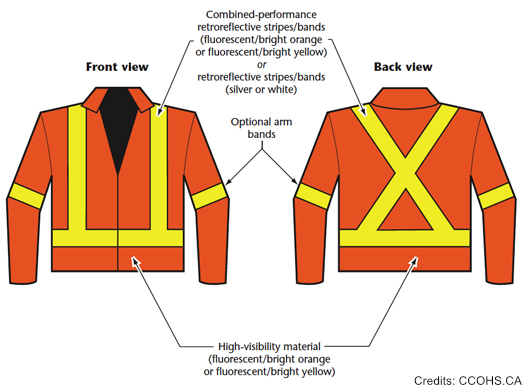
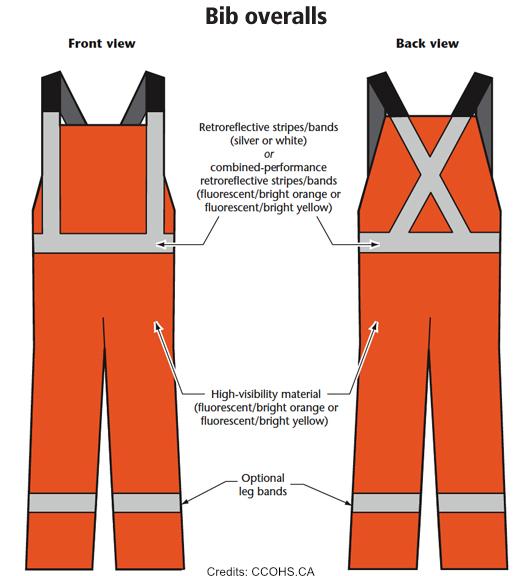
According to CSA standards, high-visibility safety clothing must have:
Stripes/bands at least 50 mm wide.
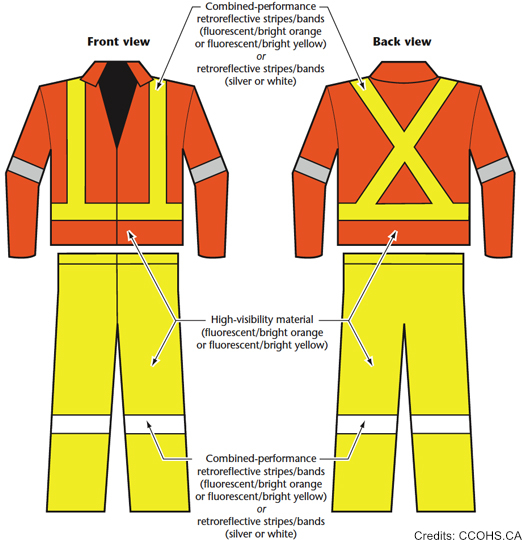
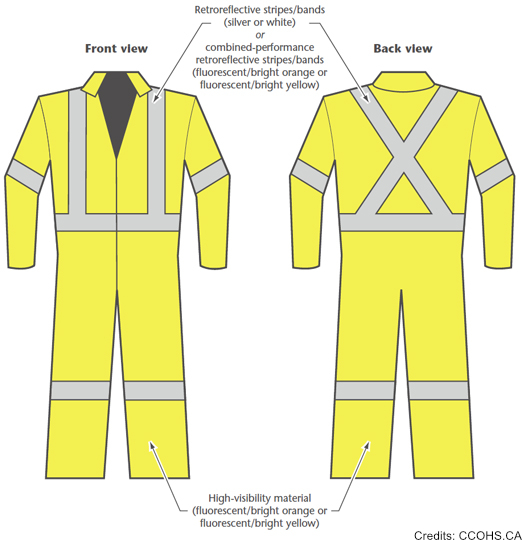
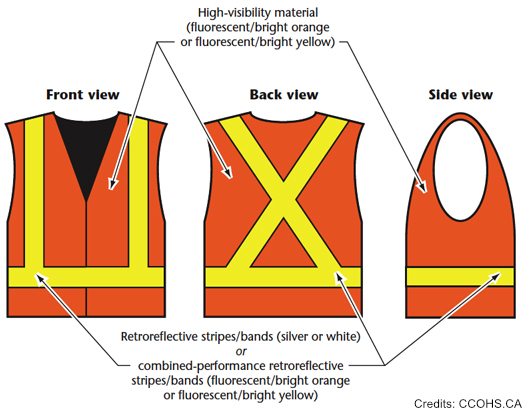
A horizontal band around the waist, and two vertical stripes over the front extending from shoulders to waist.
An “X” shape on the back from shoulders to waist.
For Class 3 garments, additional bands around both arms and legs.
Colour:
The CSA Z96-15 (R2020) Standard outlines the required colours for both the garment’s background and its stripes/bands. For instance, Class 1 garments need at least 0.14 square meters of background material, while Classes 2 and 3 require full coverage. Possible colours include fluorescent yellow-green, fluorescent orange-red, and bright yellow-green or orange-red.
Care and Maintenance:
Maintain the cleanliness and upkeep of high-visibility clothing. Dirtied or tainted retroreflective materials diminish visibility. Discard and replace any apparel showing wear, soiling, or damage as it compromises visibility levels. Buyers should verify that the high-visibility clothing meets CSA Z96-15 Standard requirements, typically indicated on the garment’s tag.
CLASSES
The CSA Standard Z96-15, which governs High-Visibility Safety Apparel, outlines criteria related to retroreflective performance (i.e., how effectively material reflects light back to its source), background material colours, and the extent of body coverage required for high-visibility components. Additionally, there are specific provisions for garments that must offer electrical flash and flame protection. Notably, while the apparel class specifications resemble those in ANSI/ISEA 107, CSA classes focus on body coverage rather than minimum surface areas.
CSA defines three classes of garments based on the coverage they provide. Each class addresses the torso (from waist to neck) and limbs, adhering to the minimum coverage areas specified for that class:
For detailed specifications, please consult the Standard. Note that while the Standard doesn’t prescribe high-visibility apparel requirements for specific job roles, it does offer examples of occupations where different classes may be suitable.
These situations are considered low risk.
Examples: Directing vehicle operators to parking or service locations. Retrieving shopping carts in parking areas. Warehouse operations. “Right-of-Way” or sidewalk maintenance workers. Workers involved in shipping or receiving operations.

Situations of moderate risk might involve:
Examples: Individuals working in roadway construction, utilities, forestry, or railways. Workers in manufacturing facilities, plants, or mills. Surveying teams. Individuals serving as school crossing monitors. Employees at parking facilities and toll booths. Ground staff and luggage handlers at airports. First responders. Law enforcement officers. Investigators at accident scenes. Employees working on railways.
Situations of moderate risk might involve:
Examples: Workers involved in roadway construction. Employees in the utility sector. Teams conducting surveys. Personnel in mining operations. Professionals in emergency response. Individuals providing roadside assistance or service patrols. Crews responsible for traffic control and flagging. Operators of towing services.